
Topics
Stiff vs liquid sourdough starter: which one should you keep?
Same culture, different hydration, surprisingly different behaviour. How the water-to-flour ratio changes the flavour, the timing and how forgiving your starter is.

It's the same wild yeast and bacteria either way. Hydration just changes how fast they work and which one of them gets the upper hand.
What the two actually are
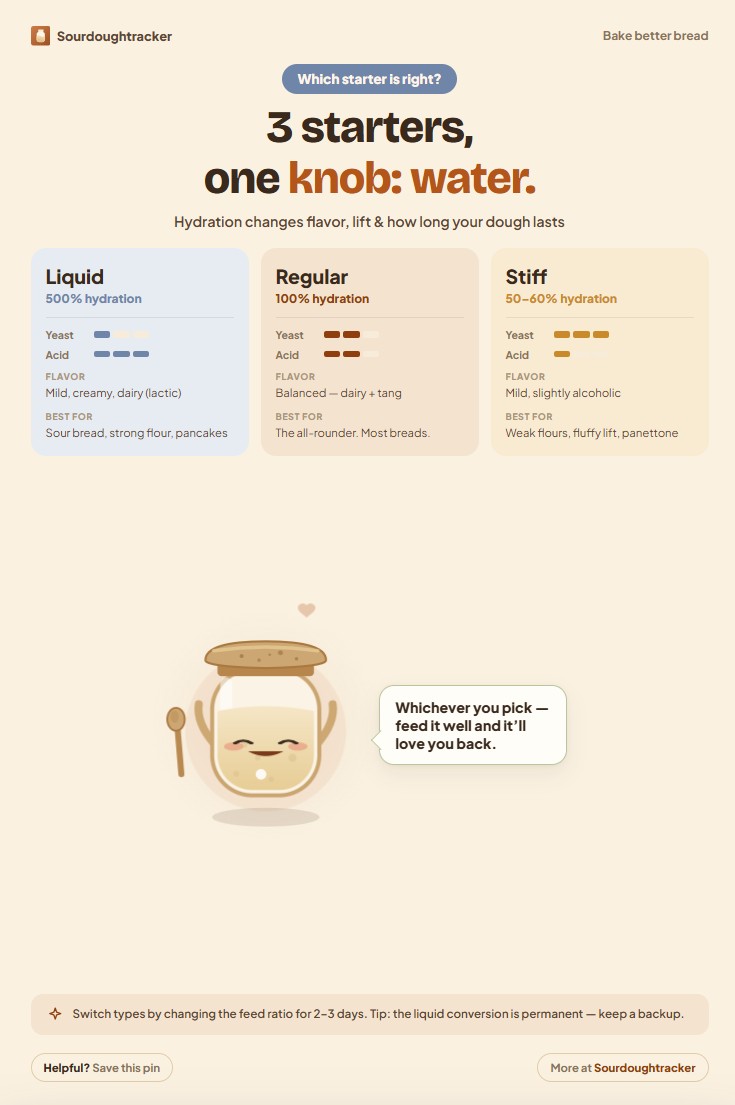
A liquid starter (the usual one, around 100% hydration) is fed with equal weights of flour and water, giving a thick-batter consistency. A stiff starter (often 50 to 60% hydration) gets about half the water, so it's a firm dough you could roll into a ball. Italian bakers know the stiff version as lievito madre or pasta madre. Both are the same living culture; only the water changes.
How hydration shifts the flavour
Water decides which microbes thrive. A wet, liquid starter favours the acid-producing bacteria, so it leans tangy and sharp, more of that classic sour twang. A stiff starter holds less free water, which tilts the balance toward the yeast and toward milder, sweeter, more aromatic acids. If your bread is too sour for your taste, moving toward a stiffer starter is one of the simplest levers you have.
Timing and how forgiving each is
A liquid starter is fast and reaches its peak quickly, which is great when you're attentive and bad when life gets in the way, because it also collapses and over-acidifies fast. A stiff starter ferments more slowly and holds near its peak for longer, so it's far more forgiving of an irregular schedule and tolerates the fridge beautifully. The trade-off: it's a little more effort to mix a firm dough than to stir a batter.
Which to keep, and why a log helps either way
Keep a liquid starter if you bake often, are around to feed it, and like a pronounced sour. Keep a stiff one if you bake on an irregular schedule, want a milder loaf, or travel. Whichever you pick, the variable you most need to see is time-to-peak, and that's invisible without a record. Logging each feed in Sourdough Tracker with a rise note makes the personality of your starter legible: you learn its real peak window instead of guessing, and switching hydration becomes an experiment you can actually read the results of.
Infographic: liquid vs stiff
Here's the whole thing on one page. Tap it to download, or pin it for your next bake.
 Download
FAQ
Frequently asked
Try Sourdough Tracker
Free plan, no credit card. We host in Germany. You can export and delete everything self-serve.
Written by
Julia Yukovich
Co-Founder + CEO
Julia is one of the Co-Founders. She handles design, development, product direction, and most of the support replies that arrive in the morning.
Read next
How to start a sourdough starter from scratch in 7 days
The minimum-effort path from flour and water to a baking-ready starter.
Read
Troubleshooting a sluggish or 'dead' sourdough starter
The decision tree for reviving a starter that stopped responding.
Read
How to read hydration % - and why it changes everything
The hydration calculation in plain words, plus a target table.
Read