
Guides
Put your sourdough starter to sleep in the fridge (and wake it back up)
You don't have to feed a starter every day. Here's how to store it cold for one to four weeks on purpose, and the three-feed routine that brings it back to full strength.

Key takeaways
Feed, wait, chill
Refrigerate a few hours after a feed, while it's active.
Rest 1 to 4 weeks
Leave it alone; hooch on top is normal.
Discard + first feed
Pour off hooch, discard most, feed at room temp.
Feed twice more
Two to three feeds until it doubles reliably.
1. Feed it, then chill it near peak
The best time to refrigerate is a few hours after a feed, when the starter is active and rising but hasn't yet collapsed. It goes into the cold with plenty of food still available, so it slows to a crawl in a well-fed state rather than starving. A loose lid (not airtight) lets gas escape. Cold doesn't kill a healthy starter; it just slows the yeast and bacteria almost to a stop.
2. Leave it for one to four weeks
A week in the fridge needs nothing from you. Up to about a month is fine for an established starter, though the longer it sits, the more it acidifies and the more wake-up feeds it will want. Expect a layer of grey-brown liquid (hooch) on top after a while, that's alcohol the yeast produced, a sign it's hungry, not a sign it's dead. Pour it off for a milder result or stir it back in for more tang.
Cold is a pause button, not an off switch
A starter that's been fed and kept anywhere from cool to cold doesn't die; it dormants. The mistake that actually kills cultures is heat (above ~50C / 120F) or true starvation over months at room temperature, not a few weeks in the fridge.
3. The three-feed wake-up
Take it out, discard down to a small amount, and feed it at room temperature. The first feed after a long sleep is usually sluggish, that's expected. Feed again 8 to 12 hours later; you should see more life. By the second or third room-temperature feed it's rising predictably and roughly doubling, which means it's ready to bake. Don't judge a fridge starter by its first feed; judge it by the third.
Two valid modes: weekly top-ups or true dormancy
There are two honest ways to run a fridge starter, and both work. Weekly top-ups: feed it roughly every 7 to 10 days, even while cold (pull it out, discard down, feed, then back in the fridge after an hour or two). It stays lively, barely needs a wake-up, and is close to bake-ready at any time. True dormancy: feed it well, chill it, and genuinely leave it for weeks. It saves flour and effort, at the cost of two or three wake-up feeds before it's strong again. Pick the mode that matches how often you bake, not what a rule says you must do.
Use a jar with a loose or simply resting lid, not a sealed clamp jar: a dormant starter still produces a little gas, and you want it to escape rather than build pressure. A stiff starter tolerates long cold spells especially well, so if you bake only occasionally, that's the hydration worth keeping.
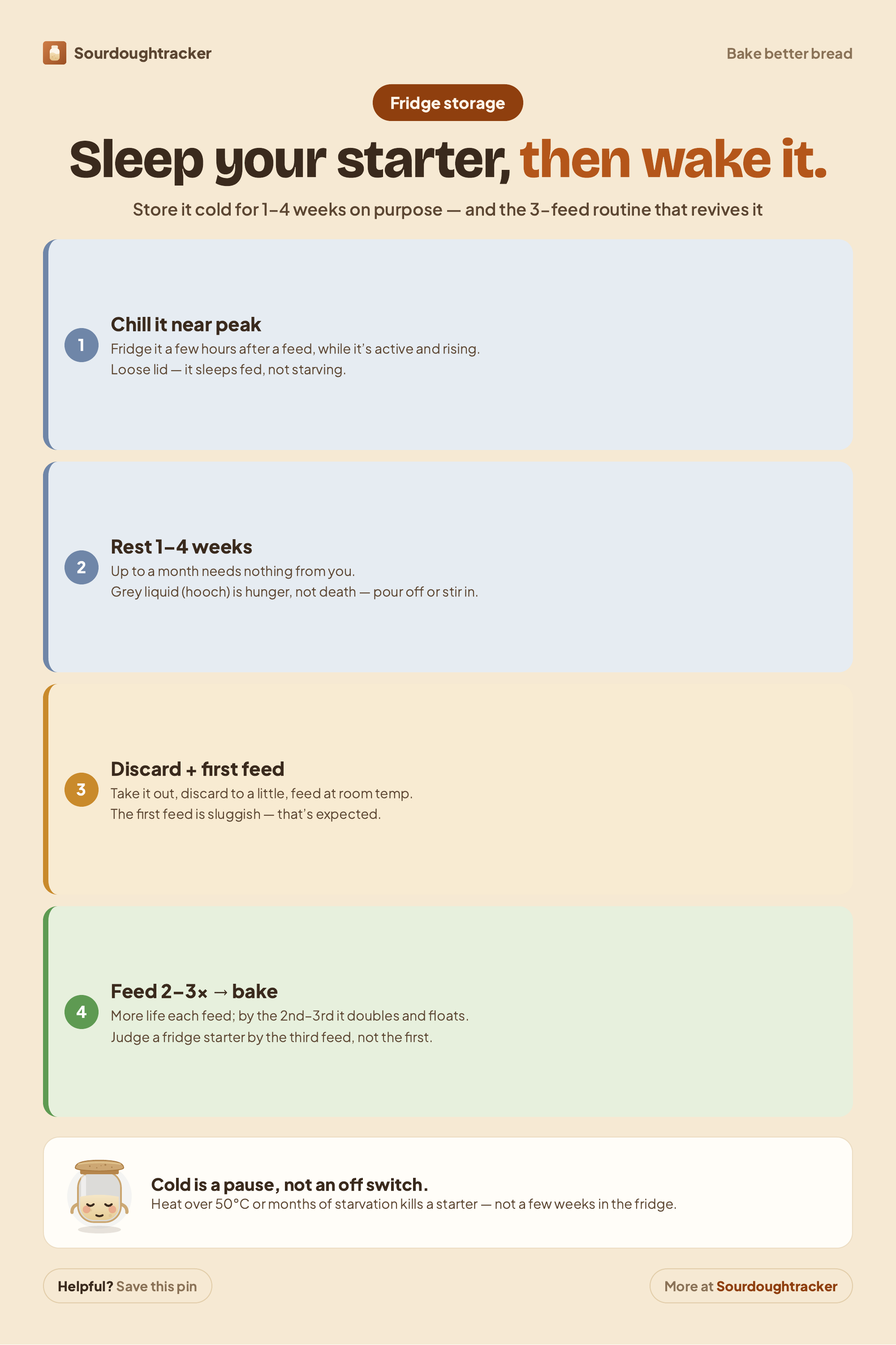
Infographic: store & revive
The whole routine on one page. Tap it to download, or pin it for your next break from baking.
 Download
FAQ
Frequently asked
Try Sourdough Tracker
Free plan, no credit card. We host in Germany. You can export and delete everything self-serve.
Read next
The Complete Sourdough Starter Feeding Guide: Ratios, Timing, and Temperature
Feeding ratios, timing, and temperature explained in one place.
Read
Stiff vs liquid sourdough starter: which one should you keep?
How hydration changes flavour, timing and how forgiving the starter is.
Read
Troubleshooting a sluggish or 'dead' sourdough starter
The decision tree for reviving a starter that stopped responding.
Read
Krümelsauer: dry your starter into crumbs for long storage
Going weeks without baking? Dry your starter into crumbs that keep for a month.
Read
Weekend baker: how to keep a sourdough starter alive when you only bake once a week
Only bake on weekends? Keep the starter happy with a low-effort fridge rhythm.
Read