
Guides
Troubleshooting a sluggish or 'dead' sourdough starter
Most starters declared dead are just hungry, cold, or off-rhythm. A diagnostic walkthrough that revives 90% of cases.

Key takeaways
Reduce + warm-feed
Discard until ~30g. Add 30g whole rye + 30g 28°C water. Stir hard. Place at 24-27°C.
Wait 12h, look for any sign
Bubbles, slight rise, or a tangy smell - any of those means you're back. No signal? Wait another 12h before re-feeding.
Repeat for 2-3 days
Twice-daily feeds at the warm spot. By day 3 you should have a doubling starter.
First: is it actually dead?
Almost certainly not. A sourdough starter is a hardy ecosystem - it survives weeks of neglect, accidental refrigeration, and most beginner mistakes. 'Dead' usually means dormant. The question to answer: is it producing CO2 (bubbles) and smelling tangy after a feed? If yes after 24-48h of effort, it's alive. If absolutely no activity after 3 days of warm, regular feeding, then yes - start a new one.
The diagnostic walkthrough
Feed it warm and let it sit. Discard until ~30g remains, add 30g whole rye + 30g 28°C water. Stir hard - oxygen helps. Place somewhere consistently 24-27°C (oven with light, top of fridge, near a heater). Wait 12 hours. If you see any bubbles or growth, you're back. Feed again, give it 12 more hours. By 24-48h you should have a doubling starter.
Common silent killers
Chlorinated tap water suppresses wild yeast. Either filter it or let a jug sit out for 24 hours so the chlorine evaporates. A lid screwed on too tight builds CO2 pressure that can suppress activity (and occasionally pop). The fridge slows the colony to almost nothing - moving from fridge straight to a feed without a counter-acclimation step often looks like death (see how to store and revive from the fridge).
When to truly start over
Pink, orange, blue, green, or fuzzy mould on the surface or in the jar. Persistent strong solvent / acetone smell that doesn't fade after 2-3 feeds. After a full 5-day rescue protocol, still zero activity. In all three cases, throw it out and start fresh - it's a one-week investment, not a heartbreak.
How long can a starter survive without feeding?
Far longer than most people fear. On the counter a starter is happy for a day or two, then gets hungry and throws hooch but stays alive for a week-plus. In the fridge it goes dormant and survives weeks, often months, between feeds - many bakers revive starters left untouched for half a year. A dried starter (smeared thin and dehydrated) keeps for years and rehydrates back to life. What you'll see after long neglect is a dark layer of hooch and sometimes a leathery grey skin on top. Neither is death - pour off the liquid, scrape past the skin to the paste underneath, and start the warm-feed protocol above.
What actually kills a starter (the short list)
Benign neglect almost never kills a starter. The genuinely fatal causes are few: real heat - leaving the jar in a preheating oven, by a stove, or feeding with water hot enough to cook the microbes (above ~50°C/120°F) - is the classic accidental killer. Coloured, fuzzy mould (pink, orange, green, blue, black with texture) means contamination has won; scraping it off doesn't work because the spores spread invisibly through the jar. Soap or bleach residue in a 'clean' jar can wipe out a feed. And, yes, accidentally rinsing it down the sink. Cold, hunger, dark hooch, a long fridge nap, the wrong flour, a skipped week - none of these are on the list. If none of the three real killers happened, your starter is dormant, not dead.
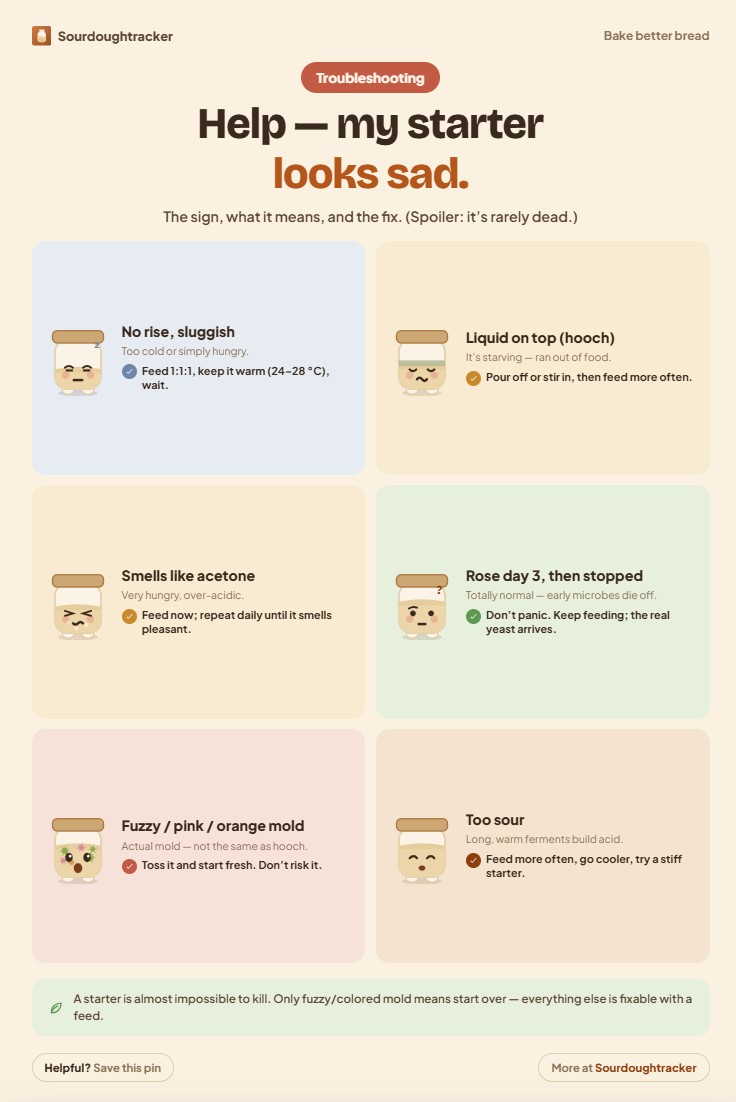
Infographic: fix a sad starter
Here's the whole thing on one page. Tap it to download, or pin it for your next bake.
 Download
FAQ
Frequently asked
Try Sourdough Tracker
Free plan, no credit card. We host in Germany. You can export and delete everything self-serve.
Read next
Sourdough starter troubleshooting: fix any starter problem
The full symptom-to-fix hub for every starter problem.
Read
How to start a sourdough starter from scratch in 7 days
The minimum-effort path from flour and water to a baking-ready starter.
Read
What 'rise %' actually tells you about your starter
Rise % in plain language, plus what 100%, 200% and 'never doubles' each mean.
Read
"I Think I Killed My Sourdough Starter" - What's Actually Happening and What to Do
Why your starter is almost certainly just hungry - and exactly how to fix it.
Read
Why Your Sourdough Starter Smells Like Acetone, Vinegar, or Gym Socks (And Whether to Panic)
Every sourdough starter smell decoded - from pleasantly tangy to genuinely alarming.
Read
Why Is My Sourdough Starter Not Rising? (and How to Fix It)
The single most common complaint - and why it is usually not death.
Read
Why your sourdough comes out dense or gummy (and how to fix each one)
Dense and gummy have opposite causes; here's how to tell which you have.
Read