
Guides
The Complete Sourdough Starter Feeding Guide: Ratios, Timing, and Temperature
Everything you need to know to feed your starter right - and stop guessing when to do it.

Key takeaways
Discard to target weight
Spoon or pour out starter until the jar holds your base weight (e.g. 50g for a 1:1:1 feed). Tare the scale with the jar on it.
Weigh in flour
Add flour to match your ratio. Daily maintenance: any bread flour. Bake-prep: 80% bread flour + 20% whole wheat or rye for a faster, more flavourful peak.
Weigh in water
Same weight as flour. Room-temperature water for counter feeds; 28-30°C to kick-start a fridge-cold starter. Stir thoroughly until no dry flour remains.
Mark the level and log
Slide the rubber band to the current level. Log the time, ambient temperature, and ratio. Rise % can be added when you check at peak.
Check at expected peak, log rise %
At peak, read the height against the rubber band. Log the rise %. That number, over 10+ feeds, tells you everything you need to know about your starter's health.
The three ratios - and when to use each
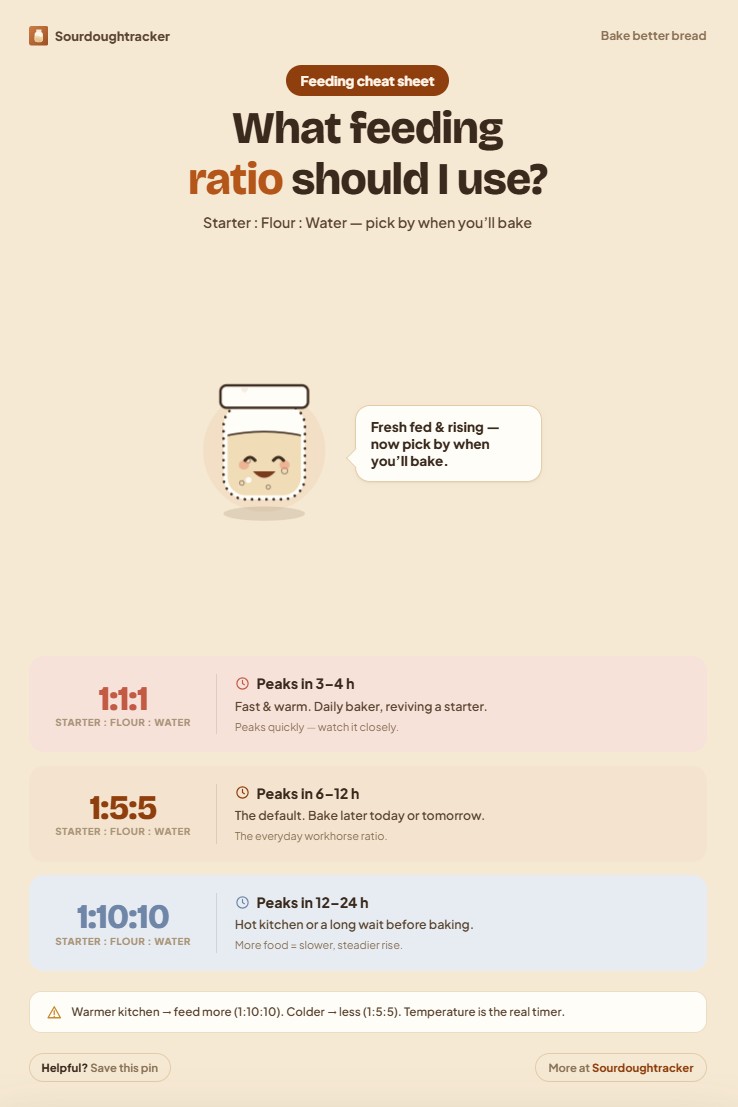
Every ratio is written as starter : flour : water by weight. 1:1:1 is the default - keep ~50g starter, add 50g flour and 50g water. Once a day on the counter, once a week in the fridge. 1:2:2 is a mild strengthening feed - keep 30g starter, add 60g flour + 60g water. Good after several fridge days when the starter is slightly sluggish. 1:5:5 is the levain-builder - keep 20g starter, add 100g flour + 100g water. The heavy dilution resets acidity and produces a predictable, vigorous peak in 10-12h. Use it the morning before baking.
Counter vs fridge: two completely different schedules
Counter (room temp, 20-24°C): feed once or twice a day. At 22°C a 1:1:1 feed peaks in 6-8h and is back at the starting line 12-16h later - that's your feed window. At 18°C the same feed takes 10-12h, so once a day is enough. Below 16°C the starter barely moves; twice-daily 1:1:1 risks over-acidifying before peak. Move it somewhere warmer instead.
Fridge (3-5°C): feed once a week. The colony goes dormant but doesn't die. Take it out every 6-7 days, discard to 50g, feed 1:1:1 with room-temperature water, leave out 4-6h until you see any activity, then return to the fridge. Skipping a week occasionally is fine; skipping three weeks means a counter revival (see how to put your starter to sleep and wake it back up).
How temperature changes everything
A rough rule: every 4-5°C warmer cuts the time to peak by about one hour. At 20°C, a 1:1:1 peak arrives in 8-10h. At 24°C, 5-7h. At 28°C, 3-4h. This matters enormously for planning: the recipe that says 'feed and wait 8h' was written in a 22°C kitchen. Your August kitchen at 28°C is a different ecosystem. Track ambient temperature with every feed and within two weeks you'll know your starter's peak time at every season.
When to feed - without a rigid clock
The starter tells you. After peak it falls. When it drops back near the rubber band mark - or starts smelling strongly of alcohol or vinegar - it's time. For most counter starters at 20-22°C that's 12-24h after a 1:1:1 feed. For fridge starters, 5-7 days. You don't need an alarm; you need a rubber band and a quick glance when you walk past the jar. Sourdough Tracker shows your last feed time on the starter card so you always know how long it's been without thinking about it.
Bigger ratios, longer windows: feeding for a real schedule
A 1:1:1 feed gets hungry fast, which is why most experienced bakers move to a bigger ratio for room-temperature maintenance. King Arthur's side-by-side test at warm room temp is a clean reference: 1:1:1 doubled and peaked at about 4 hours, 1:2:2 peaked around 8 hours, and 1:4:4 reached full peak at roughly 12 hours. More flour and water means more food per microbe, so the colony takes longer to exhaust it. Pick the ratio that lines the next peak up with when you can actually feed: 1:2:2 if you want a once-a-day rhythm without an evening top-up, 1:4:4 or even 1:10:10 if you need to skip toward 24h between feeds. The starter doesn't get weaker at a bigger ratio - it just paces itself.
Do you really have to discard before feeding?
For everyday maintenance: yes, but not because the discard is bad. Discarding keeps the jar small so a normal-sized feed is still a real dilution - feed a 200g starter with 50g + 50g and you've barely fed it at all. So pour off to your base weight first, then feed. The only time you skip the discard is when you're deliberately building a bigger levain for a bake. And the removed portion isn't waste: cold, unfed discard keeps a week in the fridge and turns into crackers, pancakes, and more. If you hate throwing flour away, keep a smaller starter (30-50g) so there's less to discard each feed.
Infographic: which feeding ratio?
Here's the whole thing on one page. Tap it to download, or pin it for your next bake.
 Download
FAQ
Frequently asked
Try Sourdough Tracker
Free plan, no credit card. We host in Germany. You can export and delete everything self-serve.
Written by
Julia Yukovich
Co-Founder + CEO
Julia is one of the Co-Founders. She handles design, development, product direction, and most of the support replies that arrive in the morning.
Read next
How to start a sourdough starter from scratch in 7 days
The minimum-effort path from flour and water to a baking-ready starter.
Read
How to Track Your Sourdough Starter Feeding Schedule (The Easy Way)
What to track, how often, and why two weeks of data changes everything.
Read
What 'rise %' actually tells you about your starter
Rise % in plain language, plus what 100%, 200% and 'never doubles' each mean.
Read
What Is Sourdough Starter Discard - And Should You Be Tracking It?
What discard is, why you have to do it, and what to do with it instead of throwing it out.
Read
Why Is My Sourdough Starter Not Rising? (and How to Fix It)
Feeding it and still no rise? Work through the usual causes.
Read
Weekend baker: how to keep a sourdough starter alive when you only bake once a week
A low-effort weekly rhythm for once-a-week bakers: fridge dormancy plus a simple Friday wake-up.
Read