
Guides
How to read hydration % - and why it changes everything
The single most useful number in sourdough. What it means, how to calculate it, and what it does to your crumb.

Key takeaways
Weigh the water
Add up every gram of water in the dough, including the water inside your starter (half of a 100%-hydration starter is water).
Weigh the flour
Add up every gram of flour, again including the flour half of the starter you mixed in.
Divide water by flour, then multiply by 100
Water ÷ flour × 100 is your hydration percentage. 750 g water and 1000 g flour = 75%.
Pick your band
65% is stiff and easy to shape, 75% is open and friendly, 85%+ is a pour-not-shape dough. Beginners should start at 68-72%.
Adjust 3-5% per bake
Log the result, then move hydration up or down by only 3-5% (about 10-20 g water per 500 g flour) on the next bake. Never jump in one leap.
The formula, written out
Take the total weight of water in the dough. Divide by the total weight of flour. Multiply by 100. That number is your hydration percentage. A dough with 750g water and 1000g flour is 75%. The starter you added counts toward both - if you added 200g of 100%-hydration starter, that's 100g flour and 100g water that you fold into the totals.
What different hydration % feel like
60-65%: stiff dough, easy to shape, dense crumb. Bagels and pretzels live here. 70-72%: classic country loaf - workable, forgiving, decent crumb opening. 75-78%: open + airy, sticky to handle, needs a couple of stretch-and-folds. 80-85%: ciabatta and high-hydration breads - serious shaping technique required, but the alveoli are spectacular. Above 85%: focaccia + flatbreads. Don't try to shape it; pour it.
Why whole-grain changes the math
Whole-grain flours absorb noticeably more water than white flour - bran is thirsty. A 75% hydration recipe with white flour will feel like 70% if you swap in whole wheat at the same weight. The crumb will be tighter and the loaf squatter. Fix: bump hydration by 5% (or pre-hydrate the bran with an autolyse step). Same recipe, different number, same result.
Logging hydration entry-by-entry
Tracking hydration on every bake is the fastest way to figure out what your starter and flour combination actually likes. After three or four bakes at different hydrations - all logged with rise %, ambient temperature, and an outcome rating - the answer becomes plainly visible. Sourdough Tracker has the field on every bake entry, so the chart that matters writes itself.
Where to start, and how to move the number
If you're new, start at 68-72% and stay there for your first handful of bakes. A 70% country loaf is workable, forgiving, and still opens nicely - chasing a 'wetter is better' number before your hands know the dough just makes a sticky mess that bakes into a dense puck. Once a recipe feels easy, raise hydration 3-5% at a time (roughly 10-20g more water per 500g flour), bake it, log the result, and only then go higher. Big jumps - 70% straight to 85% - skip the part where your handling catches up to the water.
Going the other way is harder, which is why bakers warn against it. You can't cleanly subtract water - so to firm up a too-wet dough you add flour, in 10-20g-per-500g increments, fully kneaded in. But added flour mid-mix is half-hydrated and under-developed, so it shows up as streaks and a tighter crumb. Treat flour as a last-resort patch; the real fix is writing down the right hydration next time. That's the whole reason to log it.
Match your handling to the hydration
Hydration and technique are one decision, not two. At 60-70% a short knead is fine. From 70-78%, drop the kneading and switch to stretch-and-folds - 3 to 4 sets in the first couple of hours of bulk. Above 78%, go gentler still: coil folds and a lamination develop strength without tearing a slack dough, and you shape with wet hands, not floured ones, so the surface doesn't slip. A high-hydration dough also wants tighter shaping and often a cold overnight proof to firm up before baking. If a recipe feels impossible to handle, the honest fix is usually 'drop 3% hydration', not 'try harder'.
One pro trick for getting water in without a soup: bassinage. Hold back the last 5-10% of the water, develop the gluten with the drier dough first, then work the reserved water in a splash at a time. You get the strength of a lower-hydration mix and the crumb of a higher one. It's the safest way to push past 80%.
Protein decides how much water the flour wants
The same hydration number behaves differently from flour to flour, and protein is why. Protein builds the gluten network that holds water and traps gas, so a high-protein flour both can and wants to take on more. Rough absorption deltas versus a plain all-purpose: bread flour (12-14% protein) drinks ~5-10% more, whole wheat ~10-15% more, and rye up to ~20% more. So 75% with a strong bread flour can feel like 70% with a weaker one. The lesson: hydration is only comparable within the same flour. When you change flour, expect to re-find the number - which is exactly why your choice of flour and your hydration belong in the same log.
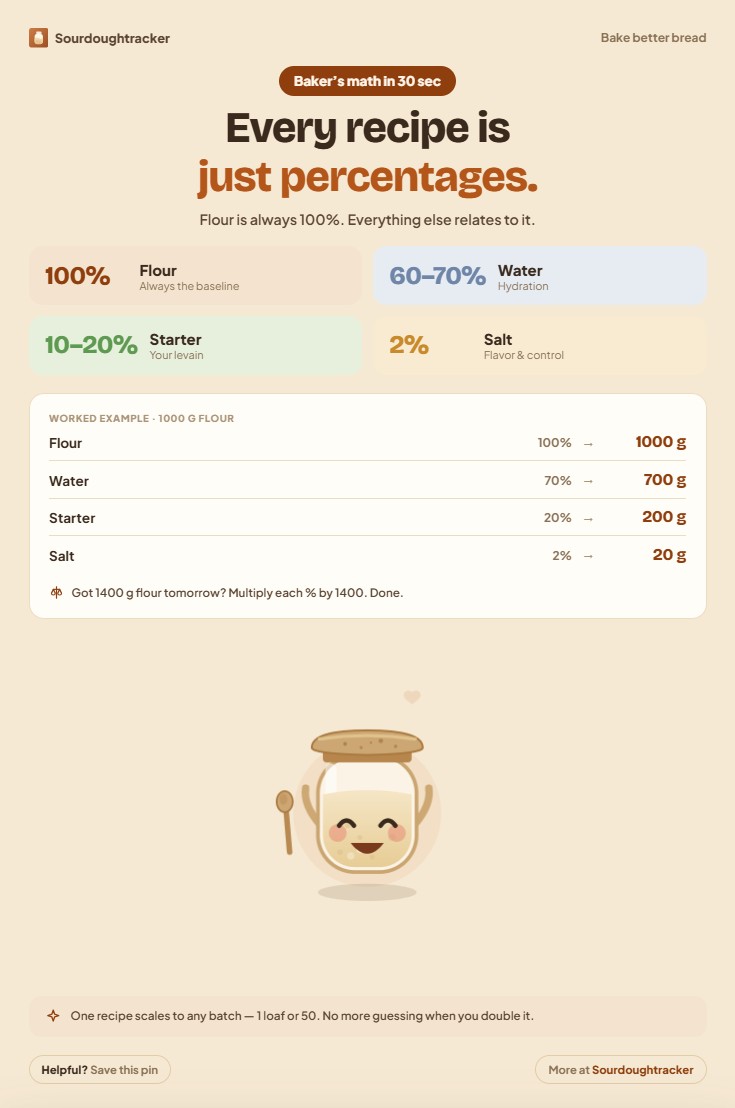
Infographic: baker's math
Here's the whole thing on one page. Tap it to download, or pin it for your next bake.
 Download
FAQ
Frequently asked
Try Sourdough Tracker
Free plan, no credit card. We host in Germany. You can export and delete everything self-serve.
Written by
Julia Yukovich
Co-Founder + CEO
Julia is one of the Co-Founders. She handles design, development, product direction, and most of the support replies that arrive in the morning.
Read next
How to start a sourdough starter from scratch in 7 days
The minimum-effort path from flour and water to a baking-ready starter.
Read
What 'rise %' actually tells you about your starter
Rise % in plain language, plus what 100%, 200% and 'never doubles' each mean.
Read
The best flours for sourdough - and when to pick which
A practical round-up of the flours every home baker actually uses.
Read
How to convert any yeast bread recipe to sourdough
Got the hydration math down? Put it to work converting any yeast recipe to sourdough.
Read
Why your sourdough comes out dense or gummy (and how to fix each one)
Too much water is the usual cause of a gummy crumb - the fix starts here.
Read