
Best of
The best flours for sourdough - and when to pick which
Eight flours every sourdough baker should know, what each does to your loaf, and the one I'd start with if I had to pick.

Choice of flour shapes everything: rise speed, crumb openness, crust colour, flavour profile. The lazy default ('use whatever bread flour the supermarket has') gets you 70% there; understanding flours gets you the last 30%.
The picks
Tools we'd recommend for home bakers looking at sourdough flours.
T550 / bread flour
The reliable workhorse
Standard German bread flour. Strong gluten, predictable behaviour, neutral taste. If you bake one loaf a week, this is your default flour - and it should be 60-80% of every bake's flour mix.
Strengths
Trade-offs
Best for
Your default 70-80% of any sourdough mix.
T1050 / whole wheat
Flavour + nutrition + faster rise
The bran is full of wild yeast and minerals - whole wheat ferments faster than white and adds nuttiness. Use 20-30% in any mix to deepen the flavour without making the loaf too dense.
Strengths
Trade-offs
Best for
20-30% of any mix to add flavour + speed.
Whole rye
Fastest fermentation, deepest flavour
The fastest-fermenting flour by a wide margin. Almost no gluten, so 100%-rye loaves are dense and pumpernickel-like. Used at 10-30% in a wheat mix, it accelerates everything and adds the classic German country-loaf tang. Rye is also the go-to for reviving a sluggish starter.
Strengths
Trade-offs
Best for
10-30% of any mix; or 100% for pumpernickel.
Spelt (Dinkel)
Sweet + delicate
Ancient wheat ancestor with a sweet, slightly nutty flavour. Lower gluten than modern wheat, so loaves are softer and don't open as dramatically. Beloved in southern Germany; underrated everywhere else.
Strengths
Trade-offs
Best for
30-100% of any mix when you want a soft, sweet loaf.
Einkorn / Emmer
Ancient wheat, deep flavour
Two of the oldest cultivated wheats. Strong nutty flavour, weaker gluten than modern wheat, often used at 20-40% to add complexity without sacrificing structure. Expensive; worth it for special bakes.
Strengths
Trade-offs
Best for
20-40% of a mix when flavour beats price.
Khorasan / Kamut
The buttery one
Large-grain ancient wheat with a butter-yellow crumb and a mild, almost dairy-like sweetness. Higher protein than einkorn but still not as forgiving as modern bread flour. Stunning in 30-50% mixes.
Strengths
Trade-offs
Best for
30-50% of a mix for a striking golden loaf.
T80 / artisan flour
Between white and whole wheat
A semi-whole flour - bran is partly retained, partly sifted out. The middle ground that small bakeries love: more flavour than white, less density than whole wheat. Classic French country-loaf flour.
Strengths
Trade-offs
Best for
70-80% of a mix when you want a real French country loaf.
Durum / semolina
The pasta wheat
Hard durum wheat ground fine. Yellow crumb, subtle nutty taste, classic in southern-Italian breads (pane di Altamura). Used at 20-40% in a mix for a distinct loaf.
Strengths
Trade-offs
Best for
Italian-style sourdoughs at 20-40% durum.
If I had to pick one mix to start with
70% T550 + 20% T1050 + 10% whole rye, 75% hydration. The T550 gives reliable structure, the T1050 adds flavour and accelerates fermentation, the rye wakes the starter and adds the country-loaf tang. Bake this mix three times before changing anything; it's a forgiving baseline that teaches you the rest.
Protein matters more than the number on the bag
The single most useful flour number isn't the Type - it's the protein percentage, printed on every bag's nutrition panel. Protein builds the gluten network that traps fermentation gas, so more protein means more structure, better oven spring, and a more open crumb that survives a long ferment. Rough bands: all-purpose / T550 sits around 9-12% protein, bread flour / French T65 / UK strong white around 12-14%, whole wheat 13-14% (but the bran cuts the dough so it bakes denser), and rye is low-gluten and can't carry a loaf on its own. There's a ceiling, though: very high-protein flour that's under-hydrated turns gummy and tough, which is why strong flours want more water. For most sourdough you want 12-13% - enough structure, still forgiving.
Translating T-numbers: US, UK and Italian equivalents
Type numbers measure ash (the mineral and bran content left after milling), not protein - which is why an American or British baker can't read them at a glance. The handy rule: the German type is the French number times ten (French T55 = German Type 550). Here's the map for the flours above:
Best flour for feeding a starter vs. baking the loaf
These are two different questions that the same search hides. For feeding a starter, you don't need bread-flour-grade protein at all - a starter isn't building a gluten network, it's a microbe farm, and it's only a small fraction of the final dough's flour. A plain all-purpose / T550 (or our 70/20/10 mix) is perfect; unbleached or organic is a touch better because it carries more wild yeast and minerals than bleached, inert white. A spoon of whole rye or whole wheat in the feed is the classic activity boost. For baking the loaf, reach for the higher-protein T65 / strong white for structure and oven spring. So you can happily feed with cheap all-purpose and still bake a specialty whole-grain loaf - the flour in the jar and the flour in the dough don't have to match.
Common flour questions, answered
Can I use all-purpose instead of bread flour for the loaf? Yes - expect a slightly slacker dough, so drop hydration by roughly 50ml per loaf, and accept a touch less oven spring. A splash of vital wheat gluten closes the gap if you want it.
Is bleached flour OK? For baking, fine. For a starter, prefer unbleached or organic - the bleaching leaves the flour more inert, so a wild-yeast culture establishes faster on unbleached. Do I actually need bread flour? No. A 2:1 all-purpose-to-bread blend, or even straight all-purpose with adjusted hydration, bakes excellent sourdough. Can rye or whole wheat be my only flour? Not ideally - rye has almost no gluten and 100% whole wheat is dense; both shine as 10-30% of a mix with a stronger white base.
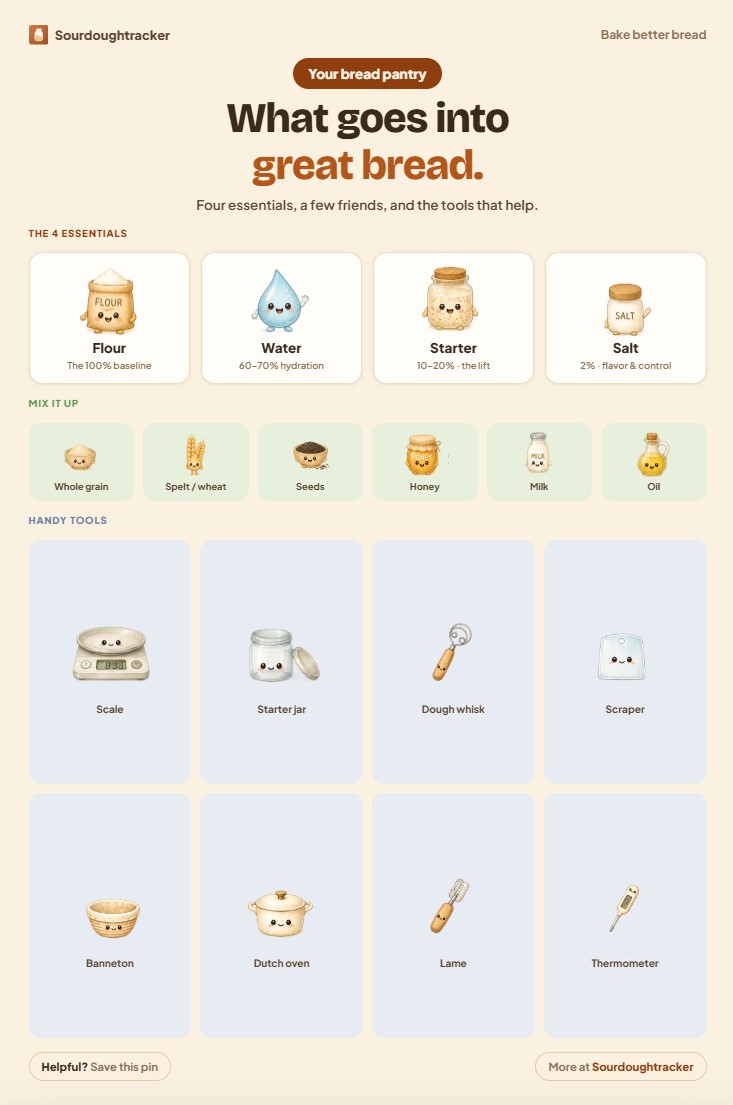
Infographic: what goes into great bread
Here's the whole thing on one page. Tap it to download, or pin it for your next bake.
 Download
Try Sourdough Tracker
Free plan, no credit card. We host in Germany. You can export and delete everything self-serve.
Written by
Julia Yukovich
Co-Founder + CEO
Julia is one of the Co-Founders. She handles design, development, product direction, and most of the support replies that arrive in the morning.
Read next
How to read hydration % - and why it changes everything
The hydration calculation in plain words, plus a target table.
Read
How to start a sourdough starter from scratch in 7 days
The minimum-effort path from flour and water to a baking-ready starter.
Read
The Complete Sourdough Starter Feeding Guide: Ratios, Timing, and Temperature
Feeding ratios, timing, and temperature explained in one place.
Read
Sourdough recipes: every bake, sorted by skill and time
Flour sorted? Pick what to bake - every sourdough recipe in one index.
Read
The Best Aprons for Sourdough Bakers (and What Makes a Great One)
Once the flour's sorted, dress for the mess - the aprons that survive a baking day.
Read