
Topics
Why your sourdough comes out dense or gummy (and how to fix each one)
Dense and gummy look similar in a sad slice but have opposite causes. Tell them apart and the fix is obvious, fix the wrong one and you'll chase your tail for weeks.

Dense is a fermentation problem; gummy is usually a baking problem. Diagnose the wrong one and every change you make pushes the loaf further from where you want it.
First, tell dense and gummy apart
Dense means tight, small holes and a heavy loaf, it never rose enough. Gummy means a sticky, pasty, almost raw-feeling crumb that clags on the knife, the holes might be fine but the texture is wet and claggy. They feel related because both come out of a disappointing slice, but one is about how the dough fermented and the other is mostly about the bake and the cooling. Naming which you actually have is 80% of solving it.
Dense: under-fermented, or a weak starter
A dense loaf almost always means the dough didn't ferment enough before baking, so there wasn't enough gas to open the crumb. Two usual causes: the starter wasn't at peak when you mixed (so it was sluggish from the start), or the bulk rise was cut short, often because a cool kitchen slowed it and the clock said it was time anyway. The fix is to ferment to the dough's actual state, not the recipe's clock: a stronger starter used at peak, and a longer bulk in a cool room.
Gummy: under-baked, or sliced too soon
Gummy crumb is usually the opposite end of the process. The two big culprits: the loaf came out before the inside was set (pull it later, or check the internal temperature, around 96 to 99C for most sourdough), or, just as common, it was cut while still warm. A sourdough loaf keeps cooking and setting as it cools; slicing into a hot loaf releases steam the crumb needed and leaves it pasty. The cruel fix is patience: let it cool fully, often a couple of hours, before the first cut. Over-fermentation can also cause a gummy, slack crumb, which is why the diagnosis matters.
Your log is the actual diagnostic tool
Here's why bakers stay stuck: they change three things at once and never learn which mattered. A loaf is the end of a chain, starter peak, bulk time, kitchen temperature, shaping, bake, cool, and you can't debug a chain you didn't record. Logging each bake in Sourdough Tracker (when the starter peaked, how long the bulk ran, the room temp, the result) turns "why is it always dense?" into a readable pattern: oh, every dense loaf had a bulk under four hours in a 19C kitchen. The fix stops being guesswork.
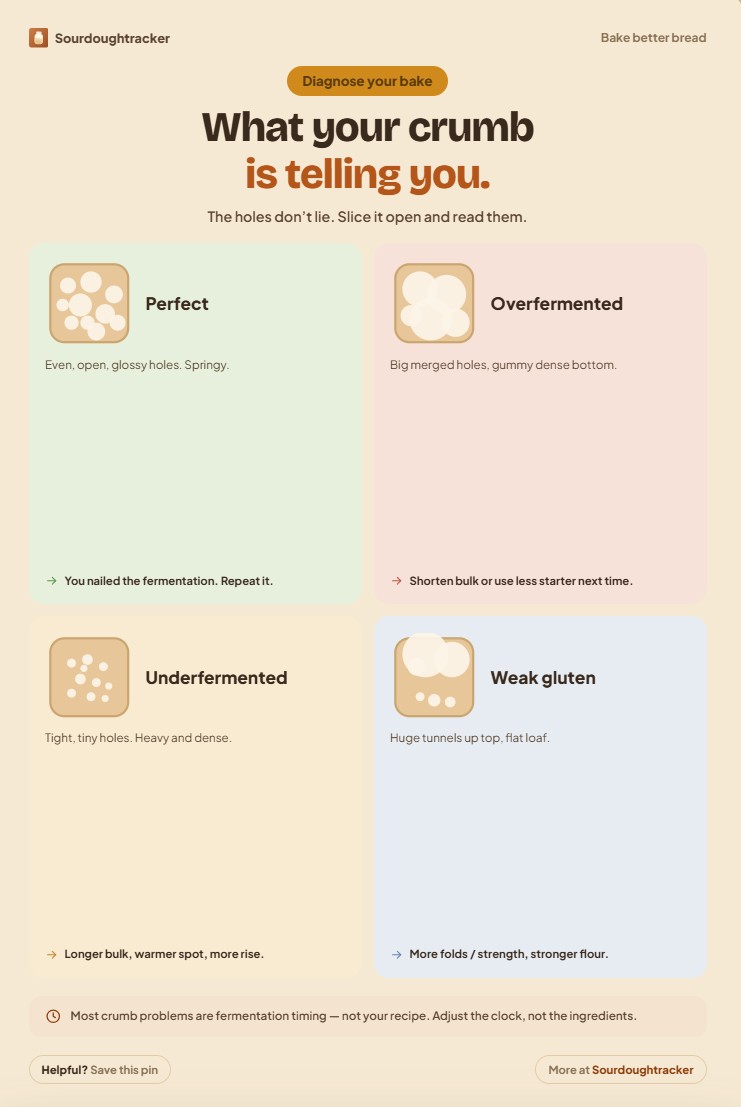
Infographic: read your crumb
Here's the whole thing on one page. Tap it to download, or pin it for your next bake.
 Download
FAQ
Frequently asked
Try Sourdough Tracker
Free plan, no credit card. We host in Germany. You can export and delete everything self-serve.
Written by
Julia Yukovich
Co-Founder + CEO
Julia is one of the Co-Founders. She handles design, development, product direction, and most of the support replies that arrive in the morning.
Read next
"I Think I Killed My Sourdough Starter" - What's Actually Happening and What to Do
Why your starter is almost certainly just hungry - and exactly how to fix it.
Read
Why Your Sourdough Starter Smells Like Acetone, Vinegar, or Gym Socks (And Whether to Panic)
Every sourdough starter smell decoded - from pleasantly tangy to genuinely alarming.
Read
What Is Sourdough Starter Hooch? (It's Not What You Think)
Hooch explained: what it is, what it means, and exactly what to do with it.
Read