
Topics
7 Signs Your Sourdough Starter Is Ready to Bake - Don't Miss #4
The float test gets all the press. Here are the seven signs that actually matter - and the one most bakers miss.

The float test gets all the press. The one that actually matters: predictable doubling at the same time, day after day.
Every baker who has baked consistently for a yearSign 1: It doubled in volume within 4-8 hours of a feed
The foundational sign. Doubled means the top of the starter is at 2× the level it was right after feeding (the rubber band mark). Not 50% rise, not almost doubled - actually doubled. A starter that doubles in 4-8h at 22-24°C has the activity level needed to leaven bread reliably. If it doubles in 12-16h at that temperature, it works but is slower than optimal; a stronger feed (1:5:5) the day before a bake will bring it to peak faster.
Quick answer
Your starter is ready to bake when it roughly doubles within 4-8 hours of a feed, on a predictable schedule, with a domed bubbly top and a pleasantly tangy smell. The float test is optional and prone to false negatives (rye never floats). If it doubles consistently, bake - don't wait for it to float.
Sign 2: The top is domed, not flat or sunken
At peak, the surface of a well-fed starter bulges upward in a dome shape - it's full of CO2 bubbles that haven't yet collapsed. A flat surface means it hasn't peaked yet or peaked and fell slightly. A sunken, liquid-looking surface means it's past peak and on its way down. Time your bake for when the dome is at its highest.
Sign 3: Web-like bubbles on the sides of the jar
Look at the jar from the side. At peak, you'll see a network of irregular, stretchy-looking bubbles clinging to the glass - the gluten web the yeast CO2 is trapped in. Fine bubbles in an even grid mean low-gluten flour (rye or high whole-grain). Irregular, open, stretchy-looking bubbles mean good gluten development and a well-leavened starter. No bubbles at the sides, even at 'peak height', means under-developed fermentation.
Sign 4: It peaks at a predictable time - day after day (the one most bakers miss)
This is the most important sign of readiness and the one that gets least attention. A single doubling tells you today's starter is active. Consistent doubling at the same time window, across five or more consecutive feeds at a stable temperature, tells you the colony is established and reliable. The difference: a starter that peaked once at 7h might peak at 11h next time and 5h the time after. A starter that reliably peaks at 7-8h for five days in a row will leaven your bread predictably every single bake. Consistency is the metric to optimise for, not a single impressive rise.
Sign 5: Smells pleasantly tangy - not alcoholic or sour
At peak, a healthy starter smells of lactic acid - mildly tangy, faintly dairy, alive. Not sharp vinegar (that's past peak), not acetone (that's hungry), not alcohol (that's starved). The smell is part of the readiness check. If the starter looks right but smells wrong, trust the smell - it's ahead of the visual.
Sign 6: Active bubbling visible even at room temperature
At or near peak, just watching the jar for a minute you should see occasional small bubbles rising through the mass. This is CO2 being released by actively fermenting yeast. If the starter is completely still - no movement visible over a few minutes of observation - it's either pre-activity (just fed, too early) or post-peak (past its high point). Peak is when you can see the starter breathing.
Sign 7: The float test (supportive, not definitive)
The famous test: drop a small teaspoon of starter in a glass of water. If it floats, the starter is aerated enough for bread. If it sinks, it may not be ready. The caveat: false negatives are common - especially with rye. Rye contains compounds called pentosans that prevent it from forming a proper gluten network, so the CO2 produced during fermentation escapes instead of being trapped. Even a highly active rye starter won't pass the float test, not because it's unready but because rye physically can't hold the gas that makes it float. A starter fed with rye or high whole-grain flour reliably doubles but will sink every time - and still bakes excellent bread. Use the float test as one supportive signal alongside the other six, not as the sole readiness criterion. If signs 1-6 are all present, you don't need the float test.
How to actually run the float test (most people do it wrong)
If you're going to use the float test as a supporting signal, do it properly - most false negatives are method errors, not an unready starter. The steps: take a clear glass of room-temperature water. Do not stir the starter first - stirring or tapping pops the trapped CO2, and a degassed sample sinks even when it's at peak and perfectly ready (this is the number-one mistake). Gently scoop about half a teaspoon from the top surface, where the gas sits, not dragged from the dense bottom. Drop the blob in; don't push it under. Test it at peak, not hours later when the gas has already escaped.
And read it as a one-way test: floating does not guarantee readiness, and sinking does not prove the opposite. King Arthur's own experiments had dough risen only 30 minutes - nowhere near ready - float happily, while at-peak rye starters sank. So treat a float as 'probably aerated' and a sink as 'check the other six signs before you worry'. If signs 1 through 6 are present, you don't need this test at all.
New starter vs. established: two different questions
There are really two readiness questions, and they get mixed up. For a brand-new starter the question is 'is it mature enough to bake at all?' - and the honest bar is high: it needs to be at least about two weeks old and double reliably on three feeds in a row before its first loaf. Baking earlier gives you a flat, dense disappointment and a wrongly-blamed recipe. For an established starter the question is per-bake: 'is it ripe right now?' That's the peak-timing judgment the seven signs above are for. If you've just started a starter from scratch, you're answering the first question; if you bake every week, you're answering the second.
How long after feeding - and what to do if it's not ready
Peak time depends on feed ratio and temperature, so learn your jar's number rather than a universal one. As rough anchors: a 1:1:1 feed at room temperature (~22-24°C) peaks in about 3-6 hours; a bigger 1:5:5 feed takes 8-12 hours; warmer kitchens shave 30-60 minutes off, and a cool room or huge feed can stretch past 12 hours. Mark the jar at feeding, note when it crests, and after a few feeds you'll know exactly when to mix.
If it simply isn't there yet, don't force it. A young or sluggish starter wants warmth (~25-27°C), a feed or two of whole rye to boost activity, and a day or two more of patience. A starter that has already collapsed past peak isn't broken - just feed it and wait for the next rise. And if it sank the float test but meets the other signs, bake anyway. The fastest way to stop guessing is to log the peak time, temperature, and feed ratio every day; the consistent number is your green light.
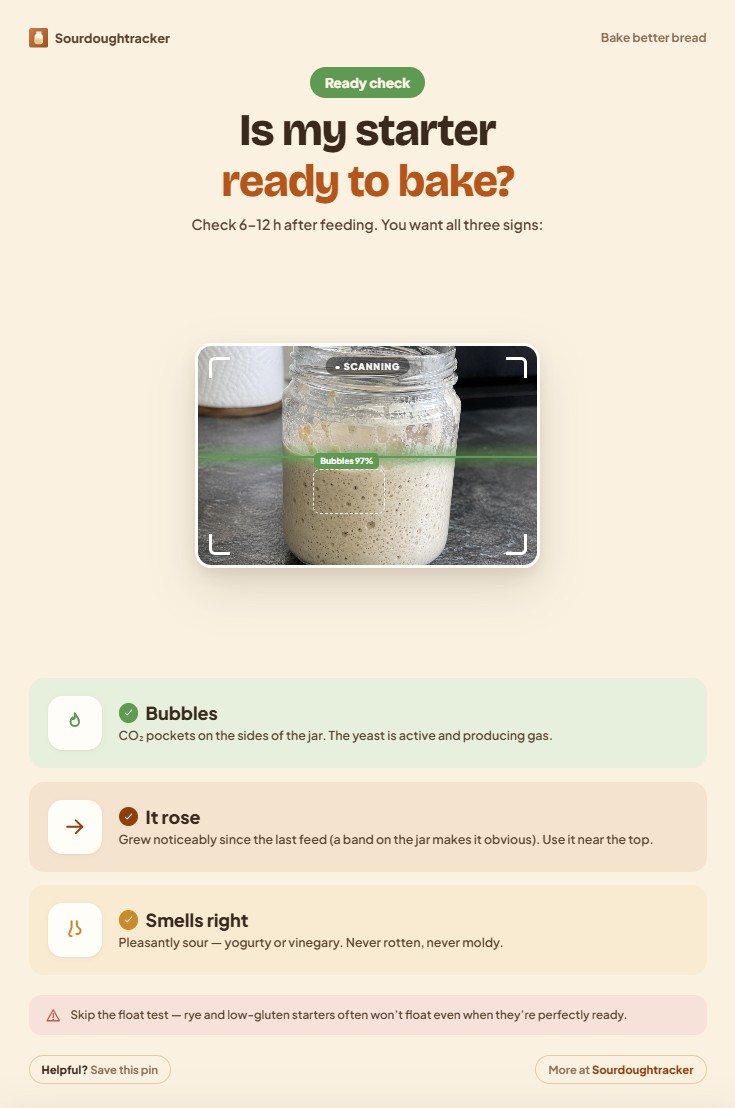
Infographic: is it ready to bake?
Here's the whole thing on one page. Tap it to download, or pin it for your next bake.
 Download
FAQ
Frequently asked
Try Sourdough Tracker
Free plan, no credit card. We host in Germany. You can export and delete everything self-serve.
Written by
Julia Yukovich
Co-Founder + CEO
Julia is one of the Co-Founders. She handles design, development, product direction, and most of the support replies that arrive in the morning.
Read next
What 'rise %' actually tells you about your starter
Rise % in plain language, plus what 100%, 200% and 'never doubles' each mean.
Read
The Complete Sourdough Starter Feeding Guide: Ratios, Timing, and Temperature
Feeding ratios, timing, and temperature explained in one place.
Read
How to start a sourdough starter from scratch in 7 days
The minimum-effort path from flour and water to a baking-ready starter.
Read