
Topics
Sourdough vs yeast: what's the difference?
Both make bread rise, but they are not the same thing. Here is a clear, honest comparison - speed, flavour, keeping quality, digestibility, effort and cost - so you can pick the right one for each bake.

Yeast is faster and almost foolproof. Sourdough is more flavour, better keeping and easier digestion - but you have to keep something alive. Neither is wrong; they are different tools.
What commercial yeast actually is
Commercial yeast - the sachet of dried granules or the block of fresh yeast from the fridge - is a single organism, Saccharomyces cerevisiae, grown and packaged in vast, pure quantities. You add it to dough, it eats the sugars in the flour, and it puffs out carbon dioxide fast. That gas is what makes the bread rise. Because it is one cultivated strain working hard, the rise is quick and reliable, and the flavour it leaves behind is clean and neutral - it mostly just makes bread taste of bread.
That predictability is the whole appeal. With yeast you can plan a loaf to the minute: mix in the morning, bake by lunch. There is very little to remember and almost nothing to keep alive - you buy it, use it, and the rest sits in the cupboard until next time.
What sourdough actually is
A sourdough starter is not a single organism but a small living community: wild yeasts that drifted in from the flour and the air, plus lactic-acid bacteria living alongside them. You feed it flour and water, it ferments, and over hours it produces both gas (to raise the bread) and acids (to flavour it). That second part is the key difference - the bacteria are why sourdough tastes tangy and complex where yeast bread is plain.
The trade-off is that sourdough is slow and it is alive. There is no sachet to open: you keep a starter, feed it, and time your bake around when it is at its peak. That ferment takes hours, often a slow overnight rise, and the starter needs ongoing care. The reward for that patience is flavour, a longer-keeping loaf and easier digestion - the things yeast simply does not do.
Side by side
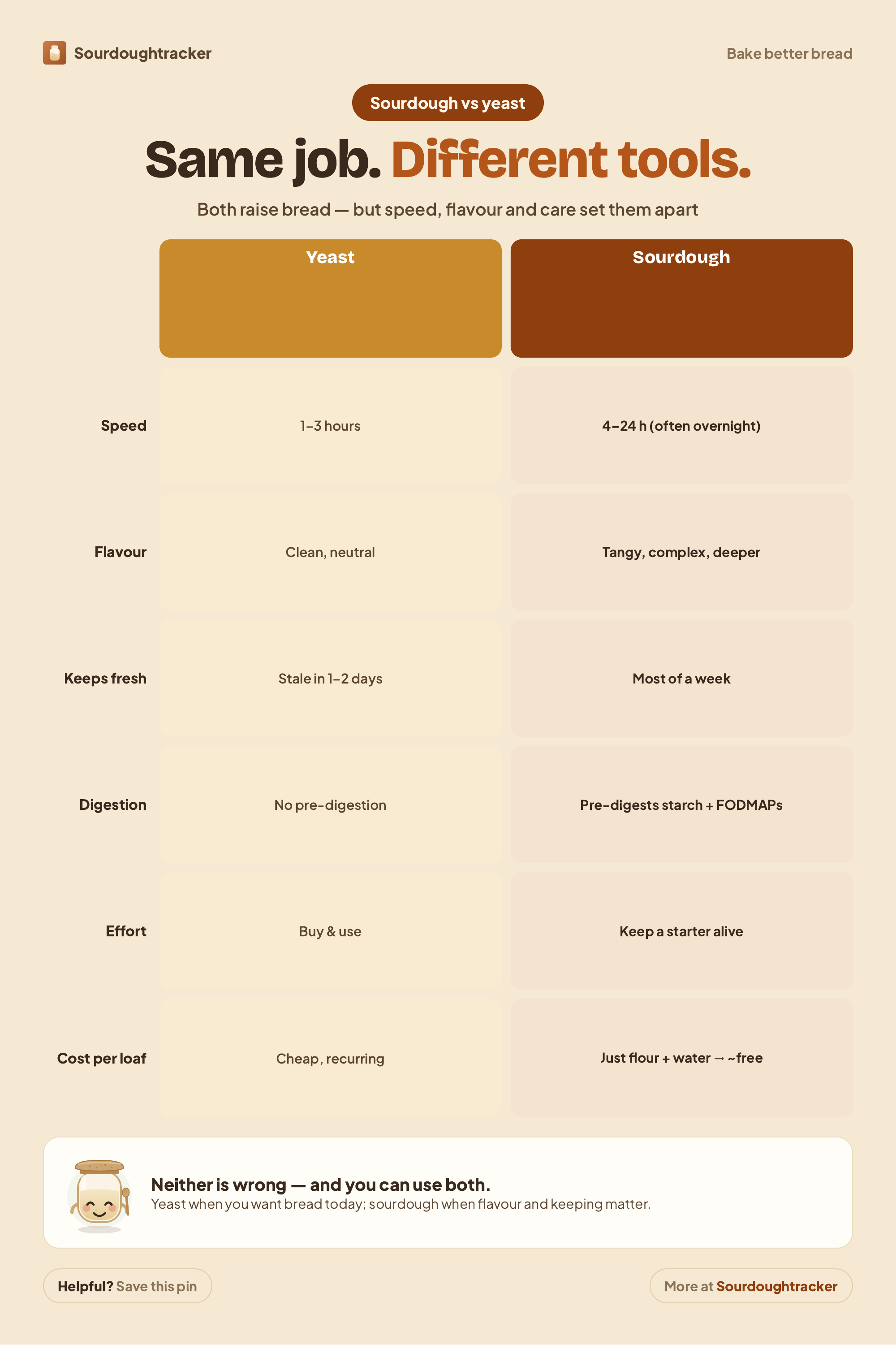
Here is the honest comparison across the things that actually matter. Yeast wins on speed and convenience; sourdough wins on flavour, keeping quality and digestibility. Everything else follows from those two facts.
Rule of thumb for swapping yeast for sourdough
Replace the yeast with active starter equal to about 20% of the flour weight, then expect a much longer proof - often a slow overnight rise instead of an hour or two. Our yeast converter does the exact maths for any recipe.
When to use which
Reach for yeast when speed and certainty matter most: a weeknight pizza dough, last-minute rolls, your first ever loaf, or any time you want bread today with no fuss. It is the dependable workhorse, and there is no shame in using it.
Reach for sourdough when flavour, keeping quality and digestion matter and you have time to let it work - a weekend bake, a loaf you want to last the week, bread for a sensitive stomach. The cost is patience and the upkeep of a starter; the payoff is a loaf yeast cannot match. If you want to go from yeast recipes to sourdough, the swap is straightforward - our yeast converter does the maths for you.
Can you use both?
Yes, and plenty of bakers do. Adding a small pinch of commercial yeast to a sourdough loaf gives you most of the sourdough flavour and keeping quality with a faster, more reliable rise - a useful hedge when your starter is sluggish or you are short on time. Some panettone, brioche and many bakery 'sourdough' loaves are made exactly this way.
Just be honest about what you are making: a loaf with added yeast is not a pure sourdough, and if it leans heavily on yeast you lose the long, slow ferment that does the digestive and keeping work. Use a little yeast as a confidence boost while your starter finds its feet, or as a deliberate choice when you want both speed and tang - not as a permanent crutch if a true sourdough is the goal.
So which should you start with?
If you have never baked bread, start with yeast for a loaf or two to learn how dough feels, how it proves and how your oven behaves - then graduate to sourdough once that is familiar. The leap is smaller than it looks. The one genuinely new skill sourdough asks for is keeping a starter healthy, and the hardest part of that is simply remembering to feed it. That is exactly the friction we built Sourdough Tracker to remove - feeding reminders, a clear read on whether your starter is ready, and a log of every bake so a good loaf is repeatable.
Keeping a starter alive is the only hard part
And it is the part Sourdough Tracker handles: feeding reminders, a clear ready-to-bake read, and a log of every bake so your best loaf is repeatable.
Infographic: sourdough vs yeast
The whole comparison on one page. Tap it to download, or pin it for later.
 Download
FAQ
Frequently asked
Try Sourdough Tracker
Free plan, no credit card. We host in Germany. You can export and delete everything self-serve.
Written by
Julia Yukovich
Co-Founder + CEO
Julia is one of the Co-Founders. She handles design, development, product direction, and most of the support replies that arrive in the morning.
Read next
How to make bread without commercial yeast
No yeast in the cupboard? Sourdough is the real answer; baking-powder breads are the fast stand-in. How each works.
Read
Is making your own sourdough worth it (and is it hard)?
Time, difficulty, cost and payoff - weighed honestly. Spoiler: easier than its reputation, and the hard part has a fix.
Read
How to start a sourdough starter from scratch in 7 days
The minimum-effort path from flour and water to a baking-ready starter.
Read