
Topics
Is sourdough bread actually healthy?
Easier to digest, gentler on blood sugar, kinder to your gut - but not gluten-free, and only if it is truly fermented. The honest, evidence-based answer.

The benefits come from real fermentation, not from the word on the label. Flour, water, salt, a living starter and time - that is what makes sourdough good for you.
The short answer
Yes - genuinely fermented sourdough is one of the healthier ways to eat bread. The long, slow fermentation does real work: it pre-digests starches, breaks down much of the FODMAPs and phytic acid, partially degrades gluten, and lowers the bread's glycaemic response. That is why many people who feel bloated by ordinary bread tolerate real sourdough better, and why it raises blood sugar more slowly. The catch is in the word 'genuinely': much supermarket 'sourdough' is yeast-raised with an added acidifier and skips the fermentation entirely, so it skips the benefits too.
Why sourdough is easier to digest
Long fermentation pre-digests the bread before you do. Over the hours that a sourdough sits and rises, the wild yeasts and lactic-acid bacteria break starches into simpler sugars, consume much of the FODMAPs (the fermentable carbs like fructans that trigger bloating in sensitive guts), and partially degrade the gluten proteins. The same bacteria produce acids that break down phytic acid, an 'anti-nutrient' in whole grains. The result is bread that arrives in your stomach already part-way through digestion.
This is the most-reported real-world benefit: people who feel heavy or gassy after a regular sandwich often find a properly fermented loaf sits far more comfortably. It is not magic and it is not a cure, but the mechanism is well understood - less of what irritates the gut survives a long ferment.
Is sourdough good for gut health?
Sourdough supports gut health on two fronts. First, the lactic-acid bacteria that ferment the dough produce organic acids and beneficial compounds, and the cooled, retrograded starch in bread behaves like a prebiotic - a resistant starch that feeds the good bacteria already in your colon. Second, by breaking down phytic acid during fermentation, sourdough makes the grain's minerals - iron, zinc and magnesium - more bioavailable, so your body can actually absorb more of them than from a quick-risen loaf.
Note one honest caveat: the live bacteria themselves do not survive the heat of the oven, so a baked loaf is not a probiotic the way yogurt is. The gut benefit comes from the fermentation that already happened to the dough and from the fibre and resistant starch in the finished bread - not from living cultures in the slice.
Is sourdough bread good for type 2 diabetes?
For most people with type 2 diabetes, sourdough is a smarter bread choice than standard white bread, because the organic acids produced during fermentation slow how fast the carbohydrate turns into blood sugar. Sourdough's glycaemic index sits around 54, versus roughly 71 for ordinary white bread, so it produces a slower, steadier rise rather than a sharp spike. It is still bread and still counts as carbohydrate - but gram for gram it is gentler on blood sugar.
Three things make the difference in practice. Choose a wholegrain or rye sourdough over a white one, because the extra fibre flattens the glucose curve further. Pair your slice with fat or protein - eggs, cheese, avocado, nut butter - which slows absorption again. And watch the portion: a slow rise from a large amount is still a large amount. Used this way, sourdough fits comfortably into a balanced, diabetes-aware diet. As always with diabetes, follow your own clinician's guidance, since individual responses vary.
Lower GI, but still carbohydrate
Sourdough's glycaemic index sits around 54 vs roughly 71 for white bread - a slower, steadier rise. Choose wholegrain, pair it with fat or protein, and mind the portion.
White vs wholegrain sourdough: which is healthier?
Wholegrain and rye sourdough are the more nutritious choice, mainly because of fibre. A wholegrain or rye loaf keeps the bran and germ of the grain, so it carries far more fibre, more minerals and more of the compounds that feed your gut and flatten your blood-sugar curve. White sourdough, made from refined flour, is lighter and gentler on a sensitive stomach but delivers less fibre and fewer micronutrients.
Neither is 'bad'. If your priority is fibre and gut health, reach for wholegrain or rye; if your stomach is touchy and you mainly want easy digestion, a white sourdough is a fine, gentler option. The fermentation benefits apply to both.
Can I eat sourdough bread every day?
Yes - eaten in normal portions as part of a balanced diet, sourdough is perfectly fine every day, and a wholegrain or rye loaf is the better daily choice for the fibre. There is no special 'downside' to daily sourdough beyond the obvious: it is still bread, still a source of carbohydrate and calories, so portion and what you put on it matter more than the fact that it is daily. If anything, swapping a daily ultra-processed sliced loaf for a real sourdough is a clear upgrade.
The catch: not gluten-free, and 'real' matters
Be clear on one thing: sourdough is not gluten-free and is not safe for coeliac disease. Fermentation reduces gluten, it does not eliminate it - enough remains to harm someone with coeliac disease, and no traditional wheat or rye sourdough should be treated as gluten-free. People with a mild, non-coeliac wheat sensitivity sometimes tolerate it better thanks to the lower FODMAPs and partly broken-down gluten, but that is comfort, not safety. If you have coeliac disease, you need certified gluten-free bread, full stop.
The second catch is authenticity. Every benefit on this page depends on real fermentation, and much supermarket 'sourdough' never gets it. So-called 'sourfaux' is risen with commercial yeast and given its tang with a bottled acidifier or sourdough flavouring, skipping the long ferment that does all the useful work. To get the benefits, the bread must be genuinely fermented - just flour, water, salt, a living starter and time. The surest way to know is to read the label, buy from a baker who ferments their own, or bake it yourself, where you control every gram and the ingredient list has nothing to hide.
'Sourdough' on the label is not enough
Much supermarket sourdough is yeast-raised with an added acidifier - none of the fermentation, none of the benefits. Read the label or bake the real thing.
The healthiest sourdough is the one you made
Put it all together and the healthiest loaf is the simplest one, made honestly: a real ferment, ideally wholegrain or rye, four ingredients and time. When you bake it at home you decide the flour, the salt, the length of the ferment and exactly what does and does not go in - which is also the single best way to be certain it is the real thing. Keeping a record of your starter and your bakes turns that control into something you can read and repeat, so a good loaf is not a lucky accident.
Track your own healthiest loaf
Bake it yourself and you control every ingredient. Sourdough Tracker keeps your starter healthy and logs every feed and bake, so the real, fermented loaf is repeatable.
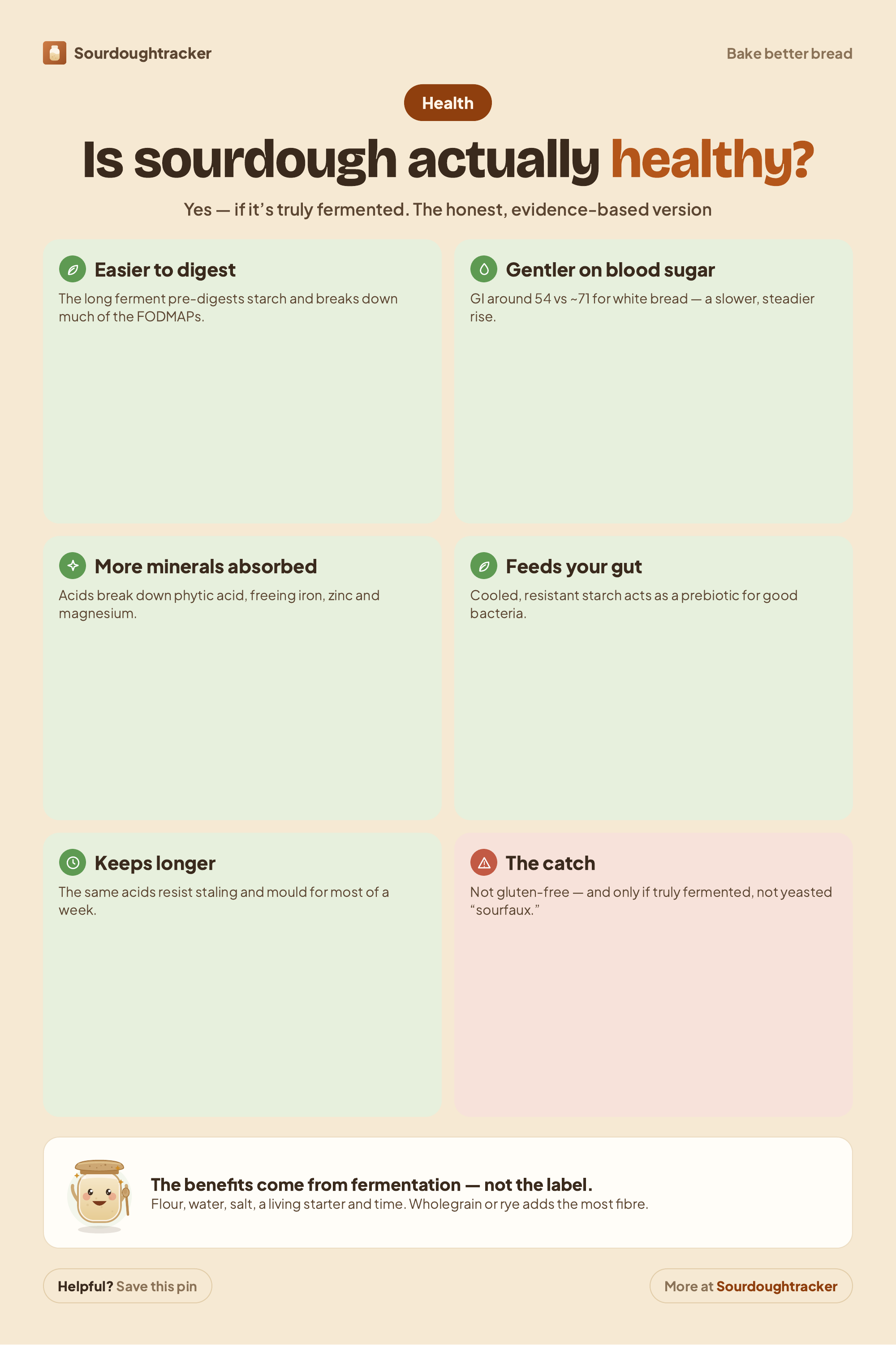
Infographic: is sourdough healthy?
The honest answer on one page. Tap it to download, or pin it for later.
 Download
A note before you take this as advice
This article is informational and is not medical advice. If you have diabetes, coeliac disease, IBS or any condition that affects what you can eat, talk to your doctor or dietitian about how bread fits your own plan - individual responses differ, and your clinician knows your case.
FAQ
Frequently asked
Try Sourdough Tracker
Free plan, no credit card. We host in Germany. You can export and delete everything self-serve.
Written by
Julia Yukovich
Co-Founder + CEO
Julia is one of the Co-Founders. She handles design, development, product direction, and most of the support replies that arrive in the morning.
Read next
What's really in bread: the '300 additives' myth, fact-checked
The additives scare, calmly fact-checked - and why bread you bake yourself has nothing to hide.
Read
Rye sourdough bread (100% rye, no kneading)
A true 100% rye sourdough: no kneading, baked in a loaf tin, deep and moist.
Read
The best flours for sourdough - and when to pick which
A practical round-up of the flours every home baker actually uses.
Read